The Teensy Vocalizer V3 is a Teensy 4.1 breakout board with onboard audio. It was designed as the embedded hardware for the Human Cyborg Relations droid vocalizer — but with its onboard audio codec, multi-protocol serial, RS-485, level-shifted I/O and eight servo outputs, it works just as well as a general-purpose Teensy 4.1 audio-and-control board for droids, props and interactive projects. For example, it can work as live input voice changer for DJ-Rex droids, Daleks etc.
Board pinout
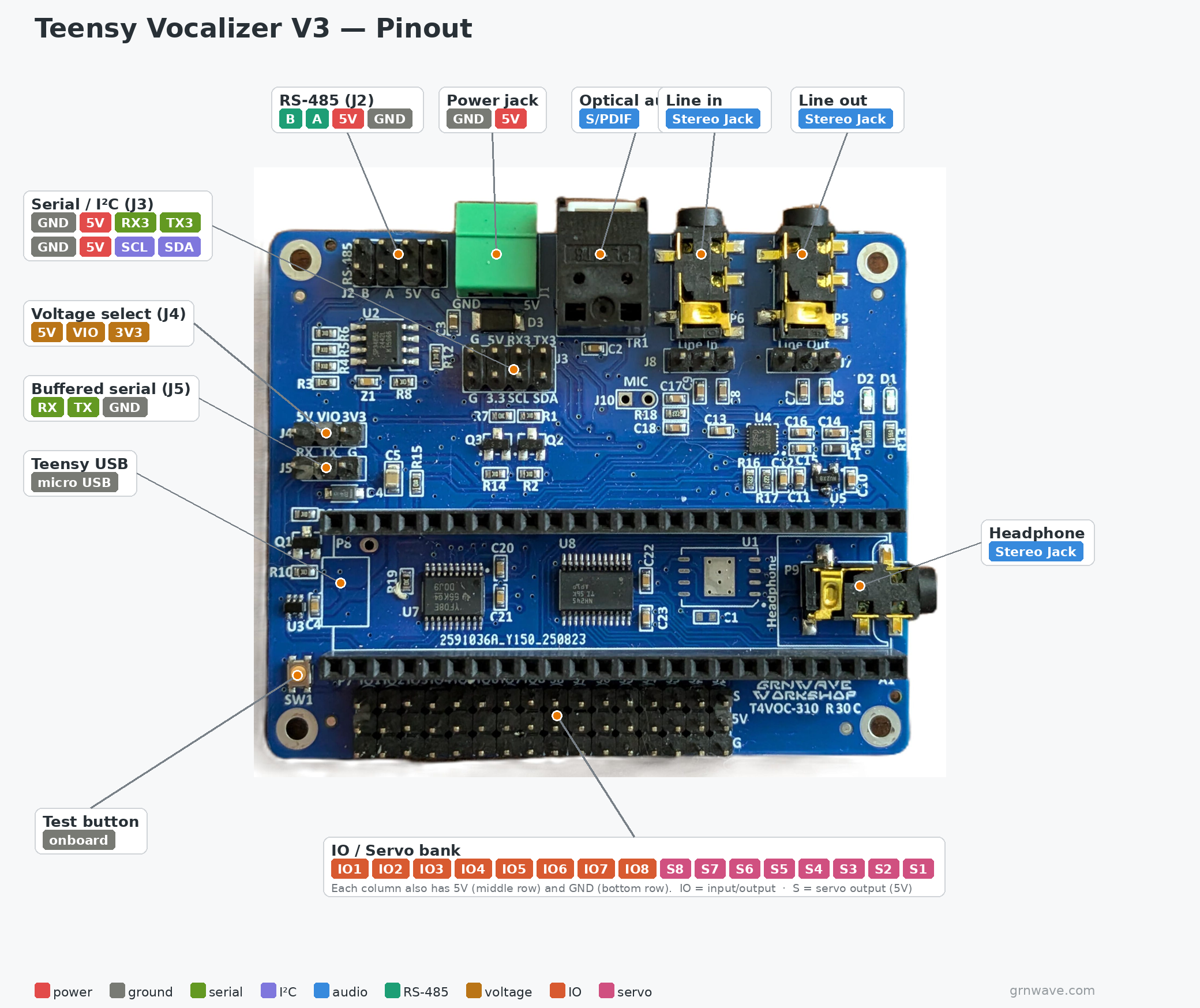
Specifications
- Microcontroller: Teensy 4.1 (600 MHz ARM Cortex-M7)
- Power: 5 V only (4.75–5.25 V) via 2-pin terminal block
- Audio: onboard codec (no separate Teensy Audio Board needed) — line out, line in, optical (S/PDIF) and headphone
- Storage: Teensy microSD socket for WAV playback and configuration files
- Comms: buffered serial (J5), serial / I²C (J3), RS-485 (J2), with a voltage-select jumper (J4) setting header I/O voltage
- I/O & servo bank: 8 general-purpose IO plus 8 servo outputs (level-shifted to 5 V), each column with its own 5 V and GND
- USB: Teensy micro-USB for programming and debug
- Onboard test button for triggering without a controller attached
Connector → Teensy 4.1 pin mapping
Extracted from the board schematic (T4VOC-30000 R30C). “D” values are Teensy 4.1 digital pins; A-numbers are the analog alias.
| Signal | Teensy 4.1 pin | Notes |
|---|---|---|
| IO / Servo bank | ||
| IO1 | D3 | Input / output, 3.3 V |
| IO2 | D4 | |
| IO3 | D5 | |
| IO4 | D6 | |
| IO5 | D24 (A10) | |
| IO6 | D25 (A11) | |
| IO7 | D26 (A12) | |
| IO8 | D27 (A13) | |
| Servo S1 | D35 | Servo output, level-shifted to 5 V |
| Servo S2 | D32 | |
| Servo S3 | D31 | |
| Servo S4 | D30 | |
| Servo S5 | D37 | |
| Servo S6 | D38 (A14) | |
| Servo S7 | D39 (A15) | |
| Servo S8 | D40 (A16) | |
| Serial / I²C header (J3) | ||
| RX3 | D16 (A2) | Serial3 RX |
| TX3 | D15 (A1) | Serial3 TX |
| SDA | D18 (A4) | Secondary I²C, level-shifted (SDA1) |
| SCL | D17 (A3) | Secondary I²C, level-shifted (SCL1) |
| Buffered serial / UART header (J5) | ||
| RX | D0 (RX1) | Through buffer; enable = D9 (OE) |
| TX | D1 (TX1) | Level-shifted output |
| RS-485 (J2) | ||
| A / B | ISL83072E transceiver | Differential pair on the primary UART |
| Direction | D41 (A17) | 485_TXen (driver enable) |
| Optical audio | ||
| S/PDIF out | D2 | |
| Audio jacks (line out / in / headphone) | ||
| analog | SGTL5000 codec | Audio handled by the codec, not direct Teensy pins |
| I²S BCLK | D22 (A8) | Codec ↔ Teensy |
| I²S LRCLK | D21 (A7) | |
| I²S DIN | D7 | |
| I²S DOUT | D8 | |
| I²S MCLK | D23 (A9) | |
| Codec I²C | SCL D20 (A6) / SDA D19 (A5) | Codec control bus |
| Voltage select (J4) | ||
| VDD_IO | jumper: 5 V / VIO / 3V3 | Sets header I/O voltage — not a Teensy pin |
| SPI (if used) | ||
| CS / MOSI / MISO / CLK | D10 / D11 / D12 / D14 | |
| Status LEDs | ||
| Green × 2 | D34, D33 | On-board, via 475 Ω |
Note: the buffered serial (J5) and RS-485 (J2) share the board’s primary UART (Serial1, D0/D1) — J5 gated by the buffer enable (D9) and J2 by the RS-485 direction line (D41). Confirm the final UART assignment against your firmware.
Software & firmware
- As an HCR droid vocalizer: runs the Human Cyborg Relations R2-D2 / Astromech Vocalizer software. See the HCR vocalizer guide and SD card setup.
- Orchestron — our Teensy 4.1 droid controller (servo animation, audio, RC/SBUS input and choreographed sequences): coming soon.
Using it as a generic Teensy 4.1 audio board
Beyond the vocalizer, the V3 is a capable base for any audio or control project that wants clean 5 V power, onboard audio, level-shifted I/O and servo drive on a Teensy 4.1. We’re building a series of example projects — see the Guides page as they roll out.